

Selecting internal clearance or preload
The operating clearance or preload in a bearing influences, among other things, the friction, load zone size and fatigue life of a bearing. Diagram 1 shows the relationship between these parameters. The diagram is generalized and based on rolling bearings under radial load.
For general applications, the operating clearance range should be within the recommended zone shown in diagram 1.
Selecting initial internal clearance and Selecting preload describe the influencing factors that must be considered and provide the methods by which you can calculate the initial internal clearance needed to achieve the degree of clearance/preload required by your application.
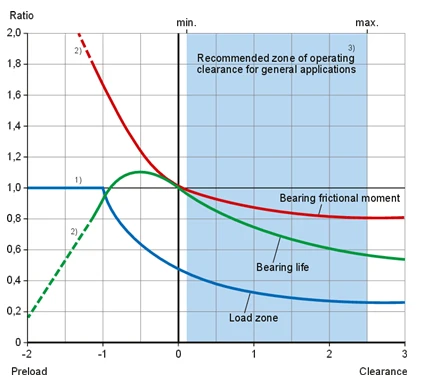
diagram 1 - Operational clearance or preload versus main operational criteria
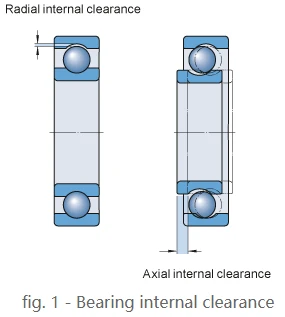
Bearing internal clearance (fig. 1) is defined as the total distance through which one bearing ring can be moved relative to the other in the radial direction (radial internal clearance) or in the axial direction (axial internal clearance).
Initial internal clearance is the internal clearance in the bearing prior to mounting.
Mounted clearance is the internal clearance in the bearing after mounting but prior to operation.
Operating clearance is the internal clearance in the bearing when it is in operation and has reached a stable temperature.
In most applications, the initial internal clearance in a bearing is greater than its operating clearance. This is because of the effects of:
interference fits with the shaft and/or housing
thermal expansion of the bearing rings and associated components
Bearings must have the appropriate operating clearance to operate satisfactorily (Importance of selecting correct clearance/preload).
In most cases, bearings require a certain degree of clearance (Selecting initial internal clearance). However, in some cases, they may require preload, i.e. negative clearance (Selecting preload).
As a general rule:
Ball bearings should have an operating clearance that is virtually zero.
Cylindrical, needle, spherical and CARB toroidal roller bearings typically require at least a small operational clearance.
Tapered roller and angular contact ball bearings should have a small operational clearance, except in applications where a high degree of stiffness or positional control is required, in which case they can be mounted with a degree of preload.


